
We Collect Unpaid Child Support & Alimony
If you are owed at least $1,000 in unpaid child support or alimony, Fair Price Lawyers is ready to help you. Our law firm charges no fees or costs unless we recover unpaid support for you. We help clients collect unpaid child support and alimony in Utah and nationwide. Simply answer a few questions through our free case review form, and we'll contact you to discuss your options.
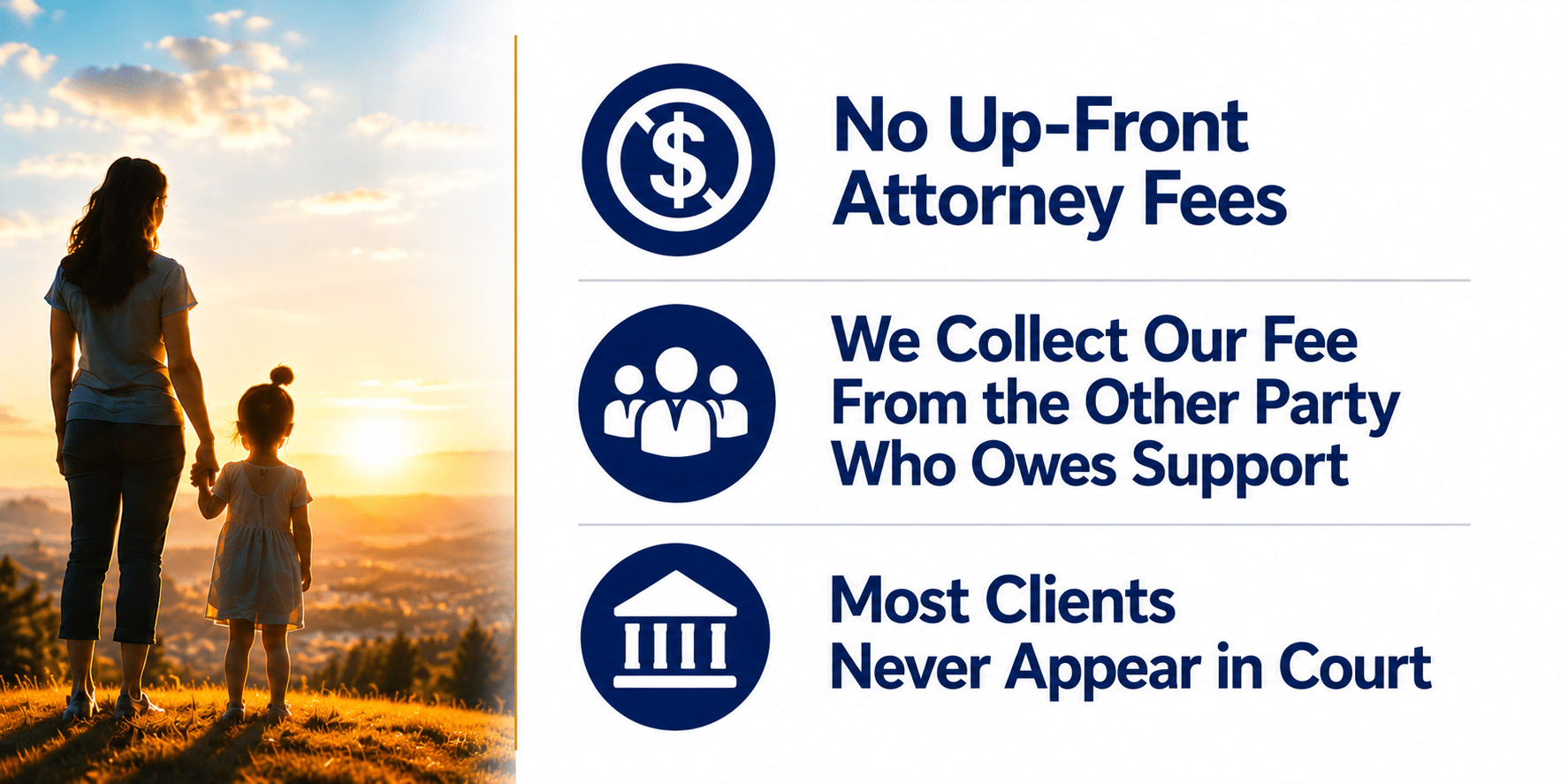
Our Mission Is to Collect Unpaid Child Support & Alimony
For over 15 years, we have seen too many children and families go without court-ordered support. We focus our practice on collecting unpaid child support and alimony because we are tired of watching parents and former spouses struggle without support.
We've helped recover child support and alimony in cases that appeared impossible. Whether the other parent lives in another state, changes jobs frequently, is self-employed, hides assets, or has ignored court orders for years, we will aggressively pursue unpaid support.
Getting started is EASY. Complete our free case review form and we'll contact you to discuss your options. If we accept your case, we can begin pursuing collection immediately.
We Collect Our Fee From the Party Who Owes Support
Unlike most law firms, we handle qualifying child support collection cases on a contingency basis. That means we don't get paid unless we successfully collect money for you, and we collect our fees from the party who owes support. We don't charge up-front attorney fees, retainers, intake fees, or processing fees.
You may wonder how we can represent clients without charging up-front attorney fees. The answer is simple: the Utah Legislature recognized that too many people were failing to pay the child support and alimony they owed and enacted Utah Code § 81-7-103 (Recovery of Child Support and Alimony Arrears). Under this law, a person who fails to pay court-ordered support can be required to pay not only the unpaid support but also reasonable attorney fees and a collection fee provided in the parties' contingency agreement, up to a maximum of 40% of the unpaid principal balance.
How We Collect Unpaid Child Support and Alimony
Fair Price Lawyers aggressively pursues unpaid child support and alimony using every available legal enforcement tool. Depending on the circumstances of your case, we may pursue collection through:
✓ Wage Garnishments
✓ Retirement Account Garnishments
✓ Bank Account Levies and Garnishments
✓ Brokerage and Investment Account Garnishments
✓ Cryptocurrency Seizures
✓ Real Property Liens
✓ Seizure of Vehicles, Boats, RVs, and Trailers
✓ Business Ownership Interests
✓ Seizure of Lawsuit Settlement Proceeds
Using advanced investigative resources and asset-location tools, we conduct nationwide searches to identify the employment, income, assets, and property of the person who owes support. Whether the obligor lives in Utah or another state, we work to locate available sources of recovery and enforce your support order.
When Will I Start Receiving Money?
In most cases, we're able to start collecting support for our client within a few months. However, every case is different. The timeline depends on many factors, including:
- How long it takes to locate the obligor;
- Whether the obligor is employed;
- Whether assets are available for collection;
- Whether the obligor owns real estate, businesses, retirement accounts, or other property; and
- Whether court action is necessary.
Some cases require more extensive investigation and enforcement efforts. If we accept your case, we will keep you informed throughout the process and provide regular updates on our progress.
How Do I Get Started?
Getting started is EASY:
Step 1: Complete our Free Case Review form (takes only a few minutes).
Step 2: We'll contact you to discuss your options.
Step 3: Sign our attorney-client agreement electronically.
Step 4: We get to work collecting the support you are owed.
No up-front fees. No obligation. No risk.
Frequently Asked Questions
My Child Is Over 18. Can You Help?
Yes. Unpaid child support does not disappear when your child turns 18.
Under Utah law, there are two important timelines to know. First is the Four-Year Rule. Generally, you have at least four years after your youngest child reaches adulthood to enforce unpaid child support.
Second is the Eight-Year Judgment Rule. If a court or the Utah Office of Recovery Services enters a judgment stating a specific dollar amount of child support owed—called a "sum certain" judgment—that judgment can be enforced for eight years from the date it is entered.
And here's the good news: those eight-year judgments can be renewed for an additional eight years, extending the time available to collect.
In fact, some of our best collection cases involve adult children because the parent who owes support has had years to build income, purchase property, and accumulate assets. If you're owed back child support or alimony, don't assume it's too late. Call Fair Price Lawyers to collect your unpaid support.
Can We Collect Unpaid Child Support or Alimony From Another State?
Yes. Using the Uniform Interstate Family Support Act (UIFSA), child support and alimony orders can often be enforced across state lines. Even if an obligor has moved out of Utah, we can often locate their employment and garnish wages directly from their out-of-state employer.
Do I Need to Live in Utah to Get Help?
No. We may be able to help regardless of where you live. Generally, we can help collect your support if you live in Utah or if the support order was issued by a Utah court or if the person who owes child support or alimony lives in Utah—even if the support order was issued in another state.
What If ORS Closed My Case?
We may still be able to collect your unpaid support even if Utah's Office of Recovery Services (ORS) or another government agency closed your case. A closed case simply means the agency is no longer pursuing collection—it does not mean the support is no longer owed. We regularly recover support in cases that government agencies closed with support still owed.
Can I Hire You If I Already Have an ORS Case?
Yes. You can hire a private attorney even if you have an open case with ORS or another child support agency. In many cases, we can work alongside government agencies to pursue additional collection efforts.
How Are We Different from ORS?
We have far greater flexibility than ORS when it comes to collecting overdue child support, alimony, daycare, and healthcare arrears. We also use a wider range of collection methods.
ORS generally relies on wage garnishments within Utah and tax refund interceptions. By contrast, in addition to those methods, we collect unpaid support through out-of-state wage garnishments, levies on retirement and other financial accounts, and liens and seizures of real estate and valuable personal property.
Think of ORS as a bishop or knight on the chessboard. We’re the queen—we can move in more directions and pursue more opportunities to recover the support you are owed.
We handle difficult collection cases, including situations where the obligor has stopped paying, changed jobs, moved out of state, or tried to avoid payment. If you've reached a dead end, try Fair Price Lawyers. Our case review is free, and there are no up-front costs.
Will I Have to Go to Court?
Usually not. Most clients never appear in court. Because you already have a support order, many enforcement options can be pursued without a hearing. If court action becomes necessary, we will explain the process and appear on your behalf.
Can We Collect Unpaid Alimony Too?
Yes. We also collect unpaid alimony. Many of the same enforcement tools used to collect child support can be used to collect alimony arrears.
Can We Collect Unpaid Reimbursements for Childcare and Child Healthcare Costs?
Yes. We can often collect unpaid childcare expenses, health insurance premiums, and uninsured medical expenses. These obligations are frequently enforceable like child support arrears, including through wage garnishment and asset seizure.
How Do I Know How Much Support Is Owed?
If we accept your case, we will review the relevant court orders and payment history to determine:
- The amount of support ordered;
- The amount paid;
- The amount unpaid; and
- Any applicable interest.
We will then determine the total arrears balance and discuss available collection options.
You may also contact ORS, which can provide you with a detailed accounting of any unpaid child support and accrued arrears.
You can also find a link the ORS's Child Support Calculator on our Forms & Links page.
Do I Need a Copy of My Court Order?
No. If we accept your case, we can usually obtain the necessary court records ourselves. If you would like a copy of your support order before hiring an attorney, you can download it through the Utah District Court's MyCase website.
What Assets Can Be Used to Collect Unpaid Child Support and Alimony?
The assets available for collection depend on the facts of each case, but unpaid child support and alimony can often be recovered from a wide variety of income sources and property. We investigate the obligor's financial circumstances and pursue every lawful collection remedy available to maximize recovery.
Wages. One of the most effective collection tools is wage garnishment. If the obligor is employed, we may be able to garnish a portion of their paycheck and have support payments sent directly toward the arrears balance. Wage garnishments can often be implemented even if the obligor lives or works in another state.
Bonuses, Commissions, and Incentive Pay. Support obligations may be collected from more than just regular wages. Performance bonuses, commissions, profit-sharing payments, and other employment incentives may also be subject to garnishment or withholding.
Bank Accounts. Funds held in checking, savings, money market, and other financial accounts may be subject to levy or garnishment. Identifying and reaching available cash assets can sometimes result in substantial recoveries.
Investment and Brokerage Accounts. Stocks, bonds, mutual funds, exchange-traded funds, and other investment accounts can represent substantial sources of recovery. These assets are frequently overlooked but may contain significant value.
Retirement Accounts. Certain retirement assets, including some 401(k) plans, pensions, IRAs, and other qualified retirement accounts, may be available to satisfy child support and alimony arrears. Special legal rules often apply, and retirement accounts can be an important source of recovery.
Business Interests. Ownership interests in businesses, limited liability companies, partnerships, and closely held corporations may provide valuable collection opportunities. Business ownership may reveal additional income streams and assets that can be used to satisfy unpaid support.
Accounts Receivable. Self-employed individuals and business owners are often owed money by customers and clients. In appropriate cases, amounts owed to the obligor by third parties may be garnished and applied toward child support arrears.
Independent Contractor Payments. Payments owed to consultants, freelancers, sales representatives, and other independent contractors may be intercepted through garnishment or similar collection remedies.
Rental Income. Rental payments received from tenants may constitute a valuable source of recovery. In some cases, tenants can be required to redirect rental payments toward satisfying unpaid support obligations.
Tax Refunds. Federal and state tax refunds may be intercepted after they're deposited in a bank account. For some obligors, tax refunds can provide substantial recoveries.
Insurance Proceeds and Lawsuit Settlements. Personal injury settlements, insurance claims, and other lump-sum payments may be available to satisfy support arrears before the funds are dissipated.
Vehicles and Recreational Property. Cars, trucks, motorcycles, boats, campers, trailers, ATVs, snowmobiles, and recreational vehicles may sometimes be seized, attached, or otherwise used to satisfy unpaid support obligations.
Precious Metals and Collectibles. Gold, silver, coins, firearms collections, artwork, jewelry, sports memorabilia, and other valuable collectibles can represent substantial assets that are often overlooked during collection efforts.
Equipment and Tools. Construction equipment, farm machinery, commercial tools, and other business equipment may have considerable value and may be available to satisfy support judgments in appropriate cases.
Cryptocurrency and Digital Assets. Cryptocurrency holdings and other digital assets have become increasingly common. In some cases, these assets can represent significant value and should not be ignored during an asset investigation.
Security Deposits and Escrow Funds. Refundable security deposits, earnest money deposits, escrow balances, and other funds held by third parties may provide additional sources of recovery.
Real Estate. Homes, rental properties, vacant land, commercial properties, and other real estate can be valuable collection targets. Support liens may be recorded against real property, and additional legal remedies may be available to recover unpaid support from property ownership.
Future Payments and Periodic Income Streams. An obligor's right to receive future payments—such as structured settlement payments, installment sale proceeds, royalties, or other recurring income streams—may also provide collection opportunities.
Every case is different. Some obligors appear to have no assets at first glance but possess significant income or property that can be discovered through investigation. Our job is to identify every potential source of recovery and aggressively pursue every lawful remedy available to collect the child support or alimony you are owed.
Using investigative resources and asset-location tools, we work to identify employment, income, bank accounts, retirement assets, vehicles, real estate, and other sources of recovery. Whether the obligor lives in Utah or another state, we aggressively pursue available collection opportunities to recover the support our clients are owed.
JOSHUA R. LUCHERINI, ESQ.

Tell Us About Your Case
